

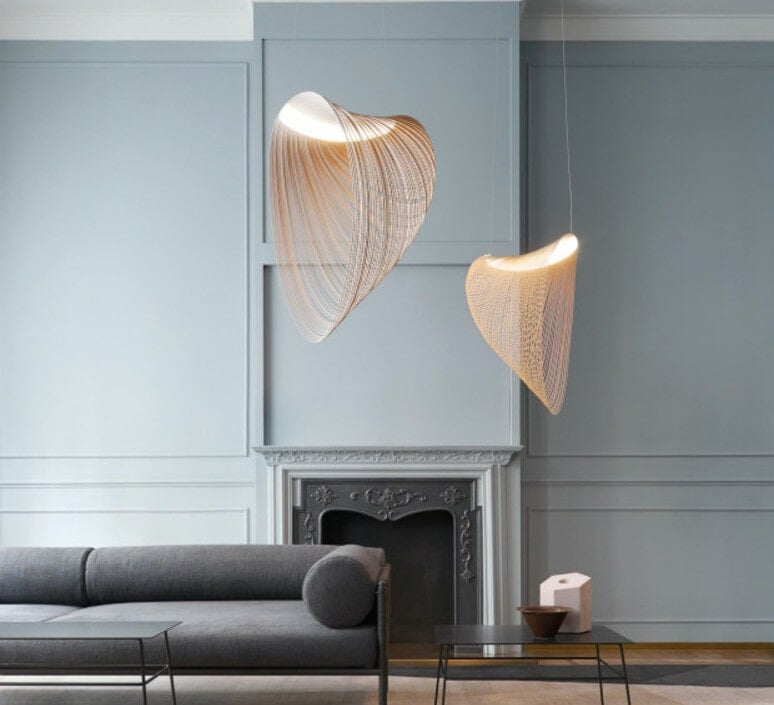

Gravity does part of the design
Illan starts as a flat sheet of plywood. Hung from the ceiling, it opens under its own weight. On Doi, a disc on a steel cable acts as a counterweight and holds a slim spotlight in tension. On Malamata, a sphere slides along the stem when you press its button, raising or lowering the glass globe.

Thin enough to almost disappear
Millimetro is a mirror-finish disc one millimetre thick, with the LED out of sight and the light directed upward. Amisol stretches a film or a mirror membrane inside an aluminum ring. Luceplan compares it to a solar sail: a strong light is projected onto the disc, which diffuses or reflects it.

A pool of light with a clean edge
Koinè sends its light through a mineral lens designed for it. Luceplan describes the result as “a broad cone of light with clearly-defined edges”. The acoustic version adds a felt cap, 60% recycled, which Luceplan says cuts reverberation nearby. Luceplan also says it was one of the first lighting companies to pair light with sound absorption.

Rice paper from a food factory, a shade from packaging
The three fans of Levante are made from a material that comes from the food industry and looks like rice paper. Magnets hold them to the core. Zile‘s shade is a bio-plastic used in packaging, which Luceplan says is 80% derived from renewable sources.

Will a light this sculptural still light the room?
Often, yes. Lumens measure how much light comes out, as opposed to how much power goes in. Luceplan lists about 3,390 for Millimetro and up to about 3,340 for Amisol. The largest Illan gives about 2,050. Those are outputs for general lighting, not accents. Doi is the exception, at about 300 lumens: plan it as an accent or a reading light.
See Luceplan in our showroom
Specifying for a client, or choosing for your own home? Illan, Koinè and Doi are installed in our Ottawa showroom. Book a visit and see them lit. Or get in touch, and we’ll go through the full Luceplan range with you.