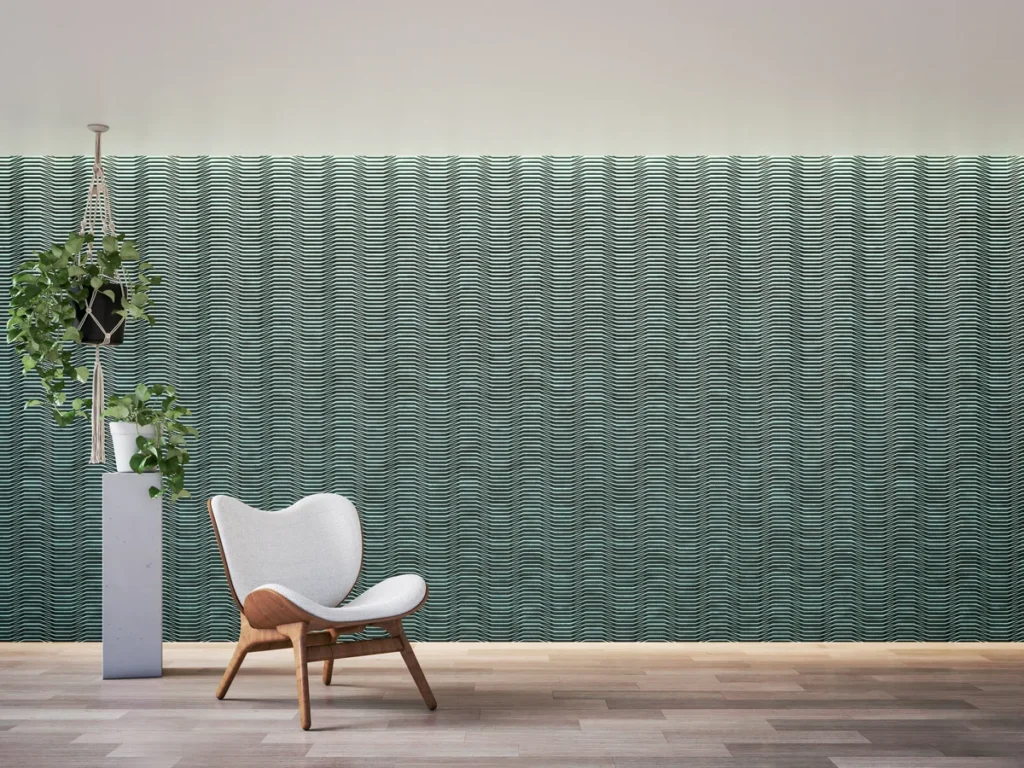

A feature wall is chosen for what it is made of. Then it’s usually lit in a way that hides what it’s made of.
Grazing and washing are the two ways to put light on a wall, and they do opposite jobs. One goes looking for texture. The other smooths it away. Choosing the wrong one is the most common reason a stone fireplace ends up looking like a photograph of a stone fireplace.
A bright room is usually a room with bright walls
Ask anyone whether a room feels bright and watch where they look. Not at the floor, and not at the table in the middle. When people are asked to judge how bright a space is, their answers follow the walls and the ceiling more closely than they follow the light landing on the floor and the tabletops. Most lighting plans put most of their effort into the floor and the tabletops.
That’s worth knowing before you add another downlight to a room that feels dim. More holes in the ceiling will put more light on the floor and more glare in your eyes, and the room can still read as gloomy. Light on a wall does the opposite. It lifts the whole room at a fraction of the ceiling fixtures.
What grazing does to a surface
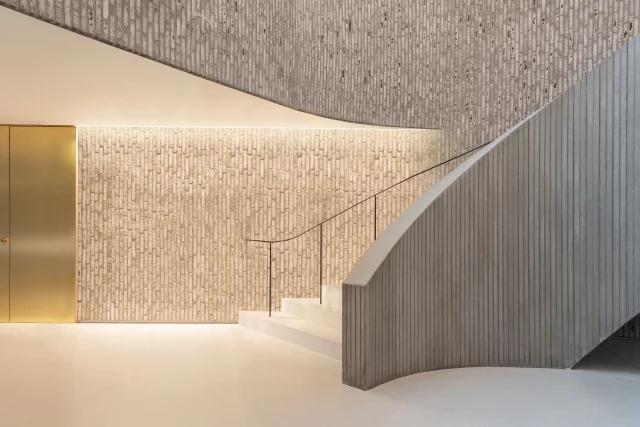
Grazing puts the fixture close to the wall, so the light runs down the face of the surface rather than arriving at it. Anything standing proud of the wall then casts a shadow the length of itself: a stone edge, a mortar joint, the saw marks in a wood slat panel. The texture stops being a colour and becomes relief.
It’s the same effect as low winter sun across a ploughed field, and it’s just as unsubtle. That’s the point. Grazing is not a way to light a wall evenly. It’s a way to make a wall look like the material it’s made of.
What washing does instead
Washing sets the fixture further out into the room, so the light meets the wall more square-on and fills in the small shadows instead of drawing them. The surface reads as one even plane, top to bottom.
Imperfections disappear, because an imperfection you can see is an imperfection with a shadow. This is the technique for a smooth painted wall, for wallpaper, for anything you want to read as a single clean field, and for the wall you hang pictures on.

Which wall gets which
Graze it if the wall has something to show: stone and stone veneer, brick, board-formed concrete, split-face tile, reeded and slatted wood, hand-trowelled plaster, heavy linen drapery.
Wash it if the wall is meant to read flat: painted drywall, wallpaper, flat millwork, a wall of artwork. Washing both walls of a hallway is also the simplest way to make a narrow corridor feel wider than it measures, and it doesn’t need a single fixture in the middle of the ceiling.
The mistake that is hardest to undo
Grazing shows the workmanship, and it doesn’t care whose workmanship it is. Four ways it goes wrong, and most of them are decided long before anyone turns a light on:
- A grazer aimed at painted drywall. The texture it finds is the taping and the fasteners.
- A washing fixture set too close to the wall. You get scallops, a row of bright arches, instead of an even field.
- Grazing a wall you also intend to hang pictures on. A frame stands off the wall, so under a grazing beam it casts a hard-edged shadow of its own down the surface beside it.
- Grazing with no dimming worth the name. Full output is the theatrical setting, and it’s the only one you’ve got.
None of these are hard to avoid. They’re settled while the wall is still a drawing, and once the drywall is up and painted the usual fix is to stop grazing it. If you want a smooth wall grazed anyway, that is a conversation to have with the drywall crew before they finish, not with the electrician afterwards.
One wall, one evening
The stone chimney breast in a great room, through an evening. At five the west windows are still doing the work, and the stone reads flat and grey, because daylight comes at that wall from the side of the room rather than down its face.
At seven the grazers come up to about a third. The courses and the mortar lines come back, and the fireplace stops being a grey rectangle. At nine the ambient light is nearly out, the grazers are lower still, and that wall is the brightest thing in the room, which is the only reason anyone is sitting where they are sitting.
Same wall, and the room reads three different ways. None of it needed another downlight.
This is the hardest thing in a house to choose from a photograph
A photograph has one exposure. Grazing is not one exposure. It’s the distance between the lit part of a surface and the unlit part, and a camera closes that distance. A stone wall that looks magnificent in a magazine and flat in your own living room is usually not a different stone. It’s a different angle of light.
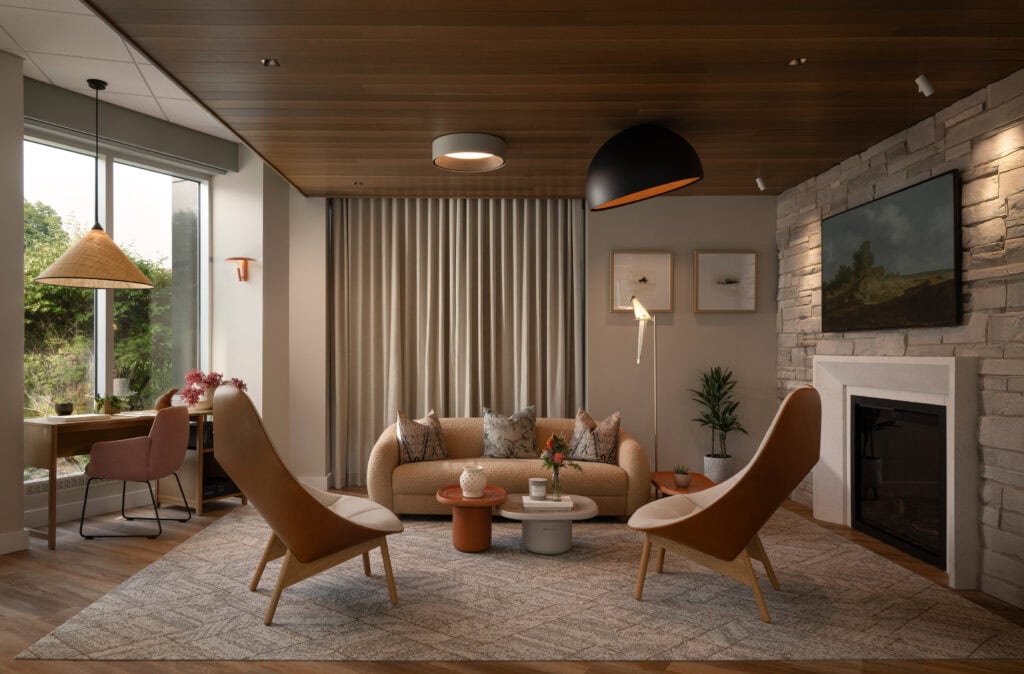
So look at it before you commit a wall to it. Every vignette in our Ottawa showroom runs on a working demonstration, the stone fireplace included, so you can stand in front of it and ask us to take it up and down. Watch for the moment the texture arrives.
Common questions
Can I graze a painted wall?
You can. Most of the time you should not. Raking light across a smooth painted surface shows the joints and the fasteners underneath it. Grazing rewards a wall with real texture and punishes a wall without any.
Do I need a special fixture, or will a downlight do?
It needs a fixture built for the job. A standard downlight sitting near a wall throws a bright arc near the ceiling and very little below it. We cover the fixture side on our commercial site, along with how far off the wall the fixture goes and the beam angle, which is how wide the pool of light spreads.
Does it have to be on a dimmer?
Yes, and it is the least of the work. Grazing at full output is dramatic, and drama isn’t what you want at nine in the evening. The wall wants to come down with the rest of the room.
Does any of this work outside?
It does, and stone and brick behave the same way outdoors. Grazing a stone facade from ground level uses the same idea, with fixtures rated for the weather.
Grazing and washing are not competing techniques. They’re answers to two different questions about one wall, and the wall has already decided which one it’s asking.